

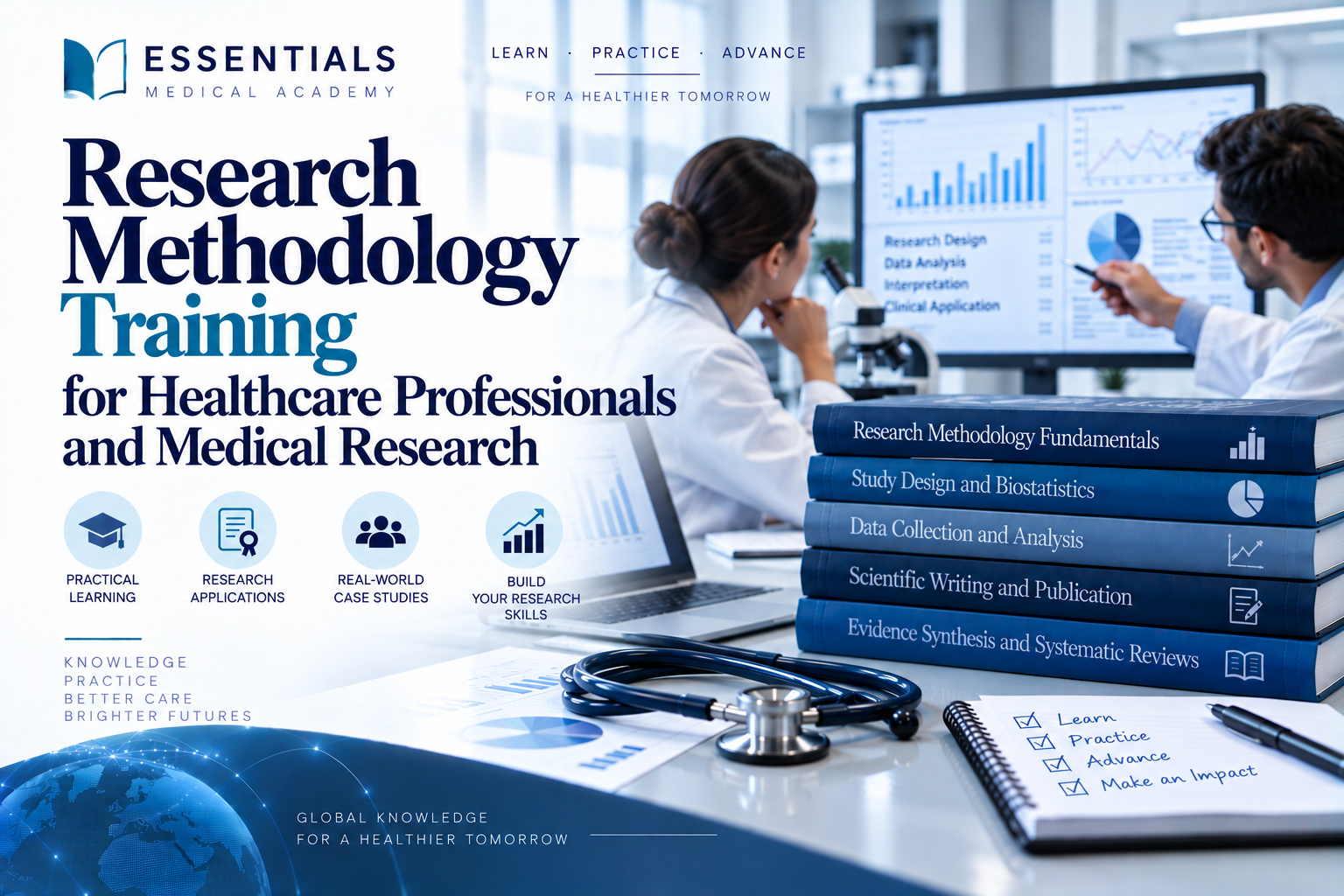
Research Methodology is the systematic approach used to plan, conduct, and evaluate a study to answer specific questions or investigate a particular problem. It explains the methods researchers use to collect information, analyze findings, and draw conclusions based on reliable evidence. A well-designed approach typically identifies the research objectives, defines the target population, selects suitable data collection techniques, and establishes procedures for interpreting results. Common approaches include quantitative research, which focuses on numerical data and statistical analysis, and qualitative research, which explores experiences, opinions, and behaviors. Mixed-methods studies combine both approaches to provide a broader understanding of complex topics. In healthcare and medical education, a clear methodological framework helps investigators evaluate treatments, examine clinical practices, and identify opportunities to improve patient care. Essentials can help learners develop an understanding of research principles and their practical applications. Selecting appropriate methods also requires attention to ethical standards, participant consent, data accuracy, and potential sources of bias. By understanding these principles, students and healthcare professionals can assess published studies more critically, support evidence-based decisions, and communicate research findings effectively.
What Is Research Methodology in Healthcare and Medical Research?
Healthcare research helps professionals investigate medical questions, evaluate treatments, understand disease patterns, and improve patient outcomes. Research Methodology refers to the systematic framework that guides how a study is planned, conducted, analyzed, and interpreted. It explains the reasoning behind the research design, the selection of participants, the collection of information, and the procedures used to answer a specific research question. A clear framework helps researchers produce findings that are credible, relevant, and appropriately interpreted.
In medical research, the chosen approach depends on the purpose of the investigation. Quantitative studies may measure treatment outcomes, compare clinical interventions, or identify relationships between variables. Qualitative studies explore experiences, beliefs, and perspectives through interviews, focus groups, or observations. Mixed-methods studies combine numerical information with descriptive findings to provide a broader understanding of complex healthcare issues.
Planning also involves defining research objectives, reviewing existing literature, selecting suitable measurement tools, and determining how information will be analyzed. Researchers must consider sample size, potential bias, limitations, and the extent to which findings may apply to other populations. Ethical requirements are equally important, particularly when studies involve patients, confidential medical records, biological samples, or sensitive health information.
A well-designed study should include transparent procedures that allow readers to understand how conclusions were reached. Depending on the research question, investigators may use randomized controlled trials, observational studies, systematic reviews, surveys, or qualitative investigations. Each design has strengths and limitations, so the selection must reflect the question being examined rather than convenience alone.
Understanding this framework benefits healthcare professionals who want to evaluate published evidence or participate in academic projects. It helps them distinguish strong findings from uncertain conclusions and recognize when additional investigation is necessary. By learning how medical studies are structured and assessed, professionals can contribute to responsible scientific inquiry and support improvements in clinical practice and healthcare services.
Why Research Methodology Is Important for Healthcare Professionals
Healthcare professionals regularly encounter new treatments, updated guidelines, diagnostic technologies, and changing recommendations. Understanding Research Methodology helps them assess whether scientific findings are reliable, relevant to their patients, and suitable for informing clinical decisions. Rather than accepting published conclusions without examination, practitioners can evaluate how evidence was collected, which participants were included, and whether the study design supports the claims being made.
One major benefit is improved critical appraisal. Healthcare workers need to recognize potential bias, inadequate sample sizes, confounding factors, and limitations in data collection or analysis. These issues can affect the reliability of reported results. Understanding the structure of a study helps professionals interpret statistical findings more carefully and distinguish an association between variables from evidence that one factor directly causes another.
Research knowledge also supports evidence-based practice. Clinicians can compare findings from different studies, consider the quality of available evidence, and combine it with professional expertise and individual patient preferences. This approach encourages thoughtful decisions rather than relying exclusively on personal experience or isolated research findings. It is particularly valuable when evidence is inconsistent or when a treatment may have different effects across patient groups.
For professionals involved in academic work, research training can improve the development of research questions, selection of appropriate study designs, preparation of protocols, and interpretation of results. It also reinforces ethical responsibilities, including informed consent, confidentiality, transparent reporting, and appropriate handling of patient information. Collaboration with statisticians, researchers, and other specialists becomes more productive when team members understand fundamental research concepts.
The benefits extend beyond individual clinical encounters. Healthcare organizations use research to evaluate service quality, identify gaps in care, assess interventions, and inform resource planning. Professionals who understand research principles can contribute more effectively to audits, quality improvement projects, and clinical studies. Although research training does not replace specialized statistical or methodological expertise, it provides a valuable foundation for lifelong learning and responsible professional practice.
The Role of Research Methodology in Evidence-Based Healthcare
Evidence-based healthcare involves combining the best available scientific evidence with professional expertise and the values, circumstances, and preferences of individual patients. Research Methodology supports this process by providing a structured way to assess how evidence is generated, identify its limitations, and determine whether findings can reasonably inform clinical decisions. Without careful evaluation of study design and data quality, healthcare professionals may draw conclusions that are stronger than the evidence allows.
Different clinical questions require different forms of evidence. Randomized controlled trials can help evaluate the effects of interventions under specified conditions, while observational studies may investigate risk factors, disease patterns, and outcomes in routine practice. Qualitative research can explain patient experiences, barriers to treatment, and perspectives that numerical measurements alone may not capture. Systematic reviews synthesize relevant studies using predefined procedures, although their reliability depends partly on the quality of the included evidence.
Evaluating evidence requires attention to participant selection, sample size, measurement accuracy, potential confounding, and the analysis methods used. Professionals should also consider whether the study population resembles their patients and whether the reported outcomes are clinically meaningful. Statistical significance does not necessarily mean that an intervention provides a substantial practical benefit, and results from one setting may not automatically apply elsewhere.
Evidence-based decisions also require balancing research findings with clinical expertise and patient preferences. A treatment supported by research may not be suitable for every individual because of medical history, potential adverse effects, accessibility, or personal priorities. Clear communication helps patients understand benefits, uncertainties, and alternatives before decisions are made.
Research principles further support the development and updating of clinical guidelines, quality improvement initiatives, and healthcare policies. By evaluating evidence systematically, professionals can identify unanswered questions and recognize when recommendations need reconsideration. This approach encourages transparent decision-making, responsible use of healthcare resources, and continuous improvement. Ultimately, evidence-based practice is strongest when scientific findings are critically assessed and applied thoughtfully to the needs of each patient.
Research Methods vs Research Methodology: Key Differences
Understanding the distinction between research methods and the broader framework guiding a study helps healthcare professionals plan investigations and evaluate published evidence. Research Methodology concerns the overall rationale and systematic approach behind a research project, including why particular methods are selected and how the study is designed to answer its research question. Research methods, by contrast, are the specific techniques used to collect, measure, organize, or analyze information.
For example, a medical researcher investigating patient satisfaction might choose a cross-sectional survey as the study design. The methods could include distributing a structured questionnaire, selecting eligible participants, recording responses, and analyzing the resulting data. The broader framework would explain why a survey is appropriate, how the sample should be selected, which limitations need consideration, and how the findings can answer the research question.
Methods can be quantitative, qualitative, or part of a mixed-methods approach. Quantitative techniques include numerical measurements, statistical analysis, and structured questionnaires. Qualitative techniques may involve interviews, focus groups, thematic analysis, and observation. Mixed-methods studies combine approaches when both numerical patterns and personal experiences are needed to understand a healthcare issue comprehensively.
The distinction matters because a suitable technique cannot compensate for a poorly designed study. A questionnaire may collect information efficiently, for instance, but biased participant selection or unclear questions can weaken the resulting conclusions. Similarly, sophisticated statistical analysis cannot correct every problem created by inadequate measurements or inappropriate study design. The overall framework should connect the research question, participant selection, data collection, analysis, and interpretation.
When developing a medical project, researchers should first define the problem and objectives, review existing evidence, and select a design that fits the question. They can then determine which collection and analysis techniques are appropriate. Ethical safeguards, transparency, and recognition of limitations should guide each stage. Understanding both concepts helps healthcare professionals conduct more coherent investigations, evaluate scientific publications more critically, and interpret findings without overstating what the evidence demonstrates.
Who Should Study Research Methodology?
Learning how medical research is planned and evaluated can benefit a wide range of healthcare professionals, students, and individuals involved in health-related investigations. Research Methodology is particularly useful for people who want to understand scientific evidence, contribute to academic projects, improve healthcare services, or make informed decisions about clinical practice. The depth of study required depends on each person’s responsibilities, educational background, and professional goals.
Medical students and recent graduates can benefit from learning how research questions are developed, study designs are selected, and published findings are interpreted. These skills can support academic assignments, dissertations, literature reviews, and future participation in clinical research. Nursing students and practicing nurses may use research knowledge to evaluate care practices, examine patient outcomes, and contribute to evidence-based improvements in their workplaces.
Doctors and other clinicians can strengthen their ability to assess medical publications, interpret treatment comparisons, and understand the limitations of diagnostic studies. Pharmacists may apply these principles when reviewing medication safety information, evaluating therapeutic evidence, or participating in clinical trials. Allied health professionals, including physiotherapists and laboratory specialists, can also use research knowledge to investigate clinical questions and assess interventions relevant to their fields.
Healthcare managers, public health practitioners, and quality improvement teams may need research training to evaluate service performance, investigate population health trends, and assess the effects of new programs. Professionals working in academic institutions, pharmaceutical research, clinical trial coordination, or healthcare policy may require more advanced instruction depending on their responsibilities.
Beginners can start with research questions, literature searching, study designs, ethical principles, and basic data interpretation. More advanced learners may explore statistical analysis, qualitative research, clinical trial design, systematic reviews, or grant development. Formal qualifications and specialized supervision may be necessary for particular research roles, especially when studies involve patients or sensitive information.
Choosing an appropriate course means considering the curriculum, instructor expertise, practical assignments, and relevance to professional objectives. Learning should include ethical research conduct and recognition of uncertainty, not just technical procedures. With suitable education and practice, healthcare professionals can become more confident readers of scientific evidence and more effective contributors to responsible research and improvements in patient care.
Research Methodology Training for Doctors and Physicians
Doctors and physicians can strengthen their ability to evaluate medical evidence, investigate clinical questions, and contribute to scientific progress through structured research education. Training through Essentials introduces healthcare professionals to study design, literature reviews, data collection, statistical interpretation, and ethical considerations in medical investigations. Participants learn how to formulate clear research questions, identify relevant scientific sources, select appropriate study populations, and evaluate the reliability of published findings. The curriculum may also explore clinical trials, observational studies, systematic reviews, and methods for minimizing bias. These skills help physicians interpret emerging evidence, assess treatment outcomes, and make more informed decisions in clinical practice. Understanding research principles is also valuable for doctors preparing academic publications, participating in clinical studies, or pursuing postgraduate qualifications. Flexible learning opportunities allow busy professionals to develop their knowledge alongside their clinical responsibilities. By combining theoretical instruction with practical examples, Essentials can support learners in understanding how research informs evidence-based medicine. Physicians should select courses that match their professional goals, experience, and academic requirements. Developing these competencies can encourage critical thinking, improve scientific communication, and support continuous professional growth throughout a medical career.
Research Methodology Training for Nurses
Nurses contribute to patient assessment, treatment delivery, health education, and the continuous improvement of healthcare services. Research training can help nursing professionals understand scientific evidence, evaluate care practices, and investigate questions arising from their daily responsibilities. Research Methodology training introduces nurses to the principles of designing studies, collecting information, analyzing findings, and interpreting results responsibly. These competencies support evidence-based nursing and encourage thoughtful decisions about patient care.
A structured course may cover research questions, literature reviews, quantitative and qualitative designs, sampling techniques, data collection tools, and basic statistical interpretation. Nurses may learn how to evaluate patient satisfaction surveys, examine treatment adherence, investigate infection prevention practices, or assess interventions designed to improve patient outcomes. Practical assignments can help participants translate clinical problems into focused research questions and identify appropriate approaches for answering them.
Ethical practice is particularly important when research involves patients, medical records, or sensitive personal information. Training should address informed consent, confidentiality, participant protection, and the responsibilities associated with collecting and storing data. Nurses also need to understand potential sources of bias, limitations in study design, and the difference between observed associations and established causal relationships.
Learning activities may include reviewing published studies, developing research proposals, designing questionnaires, and interpreting sample datasets. Collaboration with statisticians, physicians, and academic supervisors can further strengthen research quality. Nurses working in hospitals, community healthcare, education, or specialized clinical departments can adapt these skills to their professional interests.
When choosing a course, participants should consider the curriculum, instructor qualifications, practical exercises, and relevance to nursing research. Introductory programs may suit beginners, while advanced courses can address systematic reviews, research proposals, or more complex analysis. Continued learning helps nurses evaluate evidence critically, contribute to quality improvement initiatives, and support safer, more effective, patient-centered healthcare practices.
Research Methodology Training for Pharmacists
Pharmacists help ensure the safe and appropriate use of medicines through medication review, patient counseling, therapeutic monitoring, and collaboration with other healthcare professionals. Research education can strengthen their ability to evaluate pharmaceutical evidence, investigate medication-related questions, and contribute to improvements in treatment outcomes. Research Methodology training introduces pharmacists to the principles used to design studies, assess scientific publications, collect reliable data, and interpret findings within the appropriate clinical context.
Course content may include literature searching, research question development, study design, sampling, data collection, and introductory statistical analysis. Pharmacists may explore topics such as medication adherence, adverse drug reactions, prescribing patterns, patient counseling, and comparisons between treatment approaches. Depending on their career goals, learners may also study observational research, clinical trials, pharmacoeconomics, or pharmaceutical product evaluation.
Critical appraisal is an important component of professional development. Participants learn to assess whether study populations are appropriate, measurements are reliable, potential confounding factors have been considered, and conclusions are supported by the available evidence. They should also distinguish statistical significance from clinical importance and recognize why results from one population may not apply universally.
Ethical considerations are essential when investigations involve patients, medication records, biological samples, or clinical trials. Training should address informed consent, privacy, data protection, research integrity, and applicable regulatory requirements. Pharmacists must understand that studies involving human participants require appropriate approvals and safeguards before recruitment or data collection begins.
Practical learning can involve preparing research proposals, reviewing published studies, developing data collection forms, and interpreting sample results. Experienced instructors and research supervisors can help participants improve their analytical skills and identify methodological weaknesses. When selecting a program, pharmacists should consider the course level, faculty expertise, practical assignments, and relevance to pharmaceutical practice. Continued education can help pharmacists contribute to evidence-based medication management, responsible research, and improved healthcare decision-making.
Research Methodology Training for Dentists
Dentists rely on scientific evidence to evaluate treatment options, improve oral health outcomes, and understand developments in dental materials and clinical techniques. Research education can help dental professionals investigate clinical questions, assess published findings, and develop projects that address relevant oral health needs. Research Methodology training provides a structured introduction to planning studies, selecting suitable designs, collecting information, analyzing results, and interpreting evidence without overstating conclusions.
A suitable course may cover literature reviews, research objectives, sampling techniques, questionnaire design, clinical study protocols, and basic statistical concepts. Dental participants may explore topics such as periodontal disease, caries prevention, restorative materials, patient satisfaction, oral hygiene practices, and outcomes following dental procedures. Depending on the program, advanced modules may introduce randomized clinical trials, observational studies, diagnostic accuracy research, or systematic reviews.
Developing a clear research question is an important first step. Dentists need to identify the population being studied, define the intervention or exposure when relevant, and determine which outcomes will answer the question. They must also consider sample size, measurement accuracy, potential bias, and whether the proposed design is practical for the available setting. These decisions influence the reliability and usefulness of the findings.
Ethical responsibilities deserve particular attention in dental research. Studies involving patients must follow applicable requirements for informed consent, confidentiality, participant safety, and institutional approval. Research involving dental materials, clinical procedures, or patient records may require additional safeguards depending on the study design and local regulations.
Practical activities can include preparing a proposal, evaluating published dental studies, designing data collection forms, and interpreting example datasets. Mentorship from experienced researchers can help participants refine their methods and recognize limitations before beginning a project. When choosing a training program, dentists should review the curriculum, instructor credentials, assessment methods, and relevance to their specialty. Continued learning supports stronger scientific reasoning, improved evaluation of dental evidence, and responsible contributions to oral healthcare research.
Research Methodology Training for Allied Health Professionals
Allied health professionals contribute to diagnosis, rehabilitation, treatment support, and health promotion across a wide range of clinical environments. Their work generates important questions about intervention effectiveness, patient experiences, service delivery, and long-term outcomes. Research Methodology training helps these professionals understand how to investigate such questions systematically and evaluate whether published evidence is reliable and applicable to their practice.
Course content can be adapted to professions such as physiotherapy, occupational therapy, medical laboratory science, radiography, nutrition, speech and language therapy, and other allied health disciplines. Learners may study research questions, literature reviews, quantitative and qualitative designs, sampling strategies, data collection, and basic analysis. Examples could include assessing rehabilitation outcomes, evaluating diagnostic procedures, examining patient adherence, or investigating the effectiveness of educational interventions.
A strong foundation in research design helps professionals select appropriate ways to answer different questions. Quantitative approaches can measure changes in performance or compare outcomes, while qualitative methods can explore patient perspectives, barriers to treatment, and experiences of care. Mixed-methods projects may combine both approaches when numerical results alone cannot explain the full picture. Participants should also learn to recognize bias, confounding factors, measurement limitations, and uncertainty in reported findings.
Ethical responsibilities are essential when research involves patients, clinical records, or biological samples. Training should cover confidentiality, informed consent where required, data protection, participant safety, and relevant institutional approvals. Professionals must follow applicable regulations before recruiting participants or collecting protected information.
Practical assignments may include developing research proposals, evaluating published articles, creating data collection tools, and interpreting sample results. Collaboration with academic supervisors, statisticians, and multidisciplinary colleagues can improve the quality of investigations. When selecting a program, learners should assess the course level, teaching experience, practical content, and relevance to their profession. Continued development helps allied health professionals apply evidence more critically, contribute to quality improvement, and support informed decisions across diverse healthcare settings.
Research Methodology Training for Medical Students and Recent Graduates
Medical students and recent graduates encounter scientific evidence throughout their education, clinical placements, examinations, and early professional careers. Learning how research is designed and evaluated can help them understand medical publications, develop academic projects, and make more informed decisions as future practitioners. Research Methodology training introduces learners to the systematic principles behind research questions, study designs, data collection, analysis, and interpretation.
Introductory programs may cover literature searching, identifying research gaps, developing objectives, selecting appropriate study designs, and understanding basic statistical concepts. Students can explore randomized controlled trials, observational studies, surveys, case-control studies, and systematic reviews. Learning how these approaches differ helps participants determine which designs are suitable for particular medical questions and recognize the strengths and limitations of published findings.
Practical exercises are particularly useful for beginners. Participants may review scientific articles, formulate research questions, prepare short proposals, design questionnaires, or interpret sample datasets. These activities develop critical appraisal skills and demonstrate how researchers connect a clinical problem with a feasible investigation. Students can also learn to distinguish correlation from causation and understand why a statistically significant result may not always represent a meaningful clinical benefit.
Ethical education should be included from the beginning. Learners need to understand research integrity, accurate citation, responsible data handling, confidentiality, informed consent, and the need for appropriate approvals when human participants are involved. They should never assume that educational status alone permits independent clinical research or access to confidential patient information.
Recent graduates may benefit from additional instruction in protocol development, academic writing, data management, and collaboration with research supervisors. Course selection should reflect the learner’s experience, career goals, teaching support, and opportunities for practical application. Completing a short course does not replace specialist statistical advice or institutional requirements. Continued learning and supervised research experience help emerging medical professionals evaluate evidence confidently, contribute responsibly to academic projects, and build a foundation for future clinical or research careers.
Research Methodology Training for Postgraduate Students
Postgraduate students in medicine and health sciences often need advanced research knowledge to complete dissertations, develop publishable studies, or prepare for academic and clinical research careers. Their projects may involve complex study designs, large datasets, specialized populations, or questions with direct implications for patient care. Research Methodology training helps postgraduate learners build a coherent research plan and understand how individual decisions influence the validity, reliability, and interpretation of their findings.
Advanced courses may cover critical literature synthesis, theoretical frameworks, hypothesis development, sampling strategies, measurement validity, statistical planning, qualitative analysis, and mixed-methods research. Depending on the degree program, students may also study clinical trial design, diagnostic accuracy studies, epidemiology, systematic reviews, meta-analysis, or implementation research. The curriculum should reflect the research question and the academic expectations of the relevant institution.
Developing a strong protocol is a central learning objective. Students must define clear aims, justify the selected design, specify inclusion and exclusion criteria where appropriate, identify outcome measures, and plan how data will be collected and analyzed. They should also anticipate potential bias, missing data, recruitment challenges, and limitations that could affect the conclusions. Early consultation with supervisors and statistical specialists can help identify weaknesses before a project begins.
Ethical and regulatory responsibilities are especially important for studies involving patients, human samples, or confidential records. Postgraduate researchers should understand the need for institutional review, appropriate consent procedures, secure data management, transparent reporting, and honest acknowledgment of conflicts of interest. They must follow relevant approvals and should not begin restricted research activities before authorization is granted.
Practical training may involve preparing a full proposal, conducting a structured literature review, building a data analysis plan, and presenting research findings. Feedback from supervisors and experienced researchers can improve academic rigor and communication. When choosing a course, students should consider faculty expertise, software instruction where relevant, practical assignments, and alignment with dissertation requirements. Ongoing mentorship helps postgraduate researchers develop independent judgment, produce more defensible findings, and contribute responsibly to scientific knowledge and healthcare improvement.
Research Methodology Training for Clinical Researchers and Academics
Clinical researchers and academics need strong research skills to design reliable studies, evaluate scientific evidence, and contribute meaningful findings to their fields. Training through Essentials can help participants develop a deeper understanding of study design, data collection, statistical analysis, scientific writing, and research ethics. Learners can explore quantitative and qualitative approaches, examine methods for reducing bias, and understand how to select appropriate tools for different research questions. The curriculum may also cover literature reviews, hypothesis development, sample selection, data interpretation, and the preparation of manuscripts for academic publication. These competencies are valuable for university faculty, postgraduate students, clinical investigators, and healthcare professionals involved in scientific projects. Practical examples and case-based exercises can help participants apply theoretical concepts to real research challenges. Flexible learning opportunities allow busy academics and researchers to strengthen their expertise alongside teaching, clinical duties, and ongoing projects. By developing a structured approach to scientific investigation, participants can improve the quality of their work, communicate findings more effectively, and support evidence-based advances in healthcare. Choosing a suitable program requires consideration of academic objectives, previous experience, course content, and opportunities for practical application.
Research Methodology Training for Healthcare Administrators
Healthcare administrators make decisions that influence service quality, resource allocation, patient safety, workforce performance, and organizational development. Understanding Research Methodology can help administrators evaluate evidence, investigate operational challenges, and assess whether new policies or interventions achieve their intended outcomes. Rather than relying exclusively on assumptions or anecdotal feedback, they can use structured research principles to support more transparent and informed management decisions.
Training programs may introduce research question development, literature reviews, quantitative and qualitative designs, sampling techniques, data collection, and basic statistical interpretation. Administrators can apply these concepts when examining waiting times, patient satisfaction, staffing patterns, service accessibility, readmission rates, or the effectiveness of quality improvement initiatives. Learning how to select appropriate measures helps ensure that collected information addresses the actual management question.
A key competency is critical appraisal. Administrators should understand how study design, sample selection, missing information, and potential bias influence findings. They also need to distinguish correlation from causation and recognize that improvements observed in one healthcare setting may not automatically occur elsewhere. These considerations are particularly important when evaluating new technologies, operational policies, or changes in clinical workflows.
Ethical and legal responsibilities must remain central to research activities. Training should address confidentiality, secure data handling, informed consent when required, institutional approvals, and the appropriate use of patient records. Administrators must ensure that projects follow applicable regulations and organizational policies before information is collected or analyzed.
Practical learning may include developing evaluation plans, preparing surveys, reviewing published studies, and interpreting sample datasets. Collaboration with clinicians, statisticians, and quality improvement teams can strengthen project design and help translate findings into workable recommendations. When selecting a course, administrators should consider curriculum relevance, instructor experience, and opportunities to apply concepts to realistic healthcare challenges. Continued professional development supports evidence-informed planning, responsible resource management, and measurable improvements in healthcare services.
Core Competencies Required in Medical Research
Medical research requires a combination of analytical thinking, scientific knowledge, ethical awareness, and practical planning. Research Methodology provides the framework for developing these competencies and ensuring that investigations address meaningful questions using appropriate procedures. Researchers must understand how to connect their objectives with study design, participant selection, data collection, analysis, and interpretation so that their conclusions are supported by the evidence.
One fundamental competency is developing a clear, answerable research question. Investigators need to review existing literature, identify gaps in current knowledge, define objectives, and determine which study design best fits the problem. Depending on the question, they may choose a randomized trial, observational study, survey, qualitative investigation, or systematic review. Understanding the strengths and limitations of each approach helps researchers make defensible decisions.
Data management and analytical reasoning are also essential. Researchers must select suitable measurement tools, maintain accurate records, identify potential sources of bias, and understand how missing information may affect results. Basic statistical literacy helps them interpret estimates, uncertainty, and the distinction between statistical significance and clinical importance. More complex projects may require collaboration with qualified statisticians or specialized analysts.
Ethical competence is indispensable when studies involve people, biological samples, or sensitive information. Researchers should understand informed consent, confidentiality, participant protection, conflict-of-interest disclosure, and the need for appropriate ethical and institutional approvals. Honest reporting is equally important, including accurate citation, transparent presentation of results, and acknowledgment of limitations or unexpected findings.
Communication skills help researchers explain their work to supervisors, colleagues, funding bodies, and wider audiences. Preparing proposals, writing reports, presenting findings, and responding constructively to peer review are important parts of the research process. Competencies develop through formal education, practical assignments, mentorship, and supervised research experience. By combining scientific reasoning with ethical conduct and clear communication, healthcare researchers can produce more reliable findings and contribute responsibly to improvements in clinical practice and public health.
Essential Research Skills for Healthcare Professionals
Healthcare professionals encounter scientific evidence when evaluating treatments, reviewing clinical guidelines, improving services, and answering questions arising from patient care. Developing Research Methodology knowledge helps them assess the quality of that evidence and understand how investigations can be designed to address practical healthcare problems. These abilities are useful even for professionals who do not intend to become full-time researchers because informed practice depends on interpreting scientific findings carefully.
Literature searching is an essential starting point. Practitioners need to locate relevant publications, use reliable databases, identify appropriate keywords, and evaluate whether sources are current and credible. Critical appraisal then helps them examine study design, participant selection, measurement quality, potential bias, and whether conclusions are justified by the results. These steps reduce the risk of accepting misleading claims or applying findings in unsuitable settings.
Research question development is another important skill. Healthcare workers should be able to identify a problem, define a clear objective, and determine what information would help answer it. Depending on the question, appropriate approaches may include surveys, observational studies, interviews, audits, or reviews of existing evidence. Understanding the differences between these options helps professionals select realistic methods and recognize when expert support is necessary.
Basic data literacy is equally valuable. Professionals should understand common descriptive statistics, uncertainty, missing data, and the difference between correlation and causation. They should also be able to communicate findings clearly through summaries, reports, tables, and presentations. Accurate documentation and transparent reporting make results easier for colleagues to evaluate and use.
Ethical awareness must accompany every stage of research. Confidentiality, secure information handling, appropriate approvals, and informed consent where required are essential when projects involve patients or identifiable records. Training can build these skills through journal clubs, research workshops, practical assignments, and supervised quality improvement projects. Healthcare professionals should seek statistical or methodological advice when a project exceeds their expertise. Continued learning strengthens critical thinking, supports evidence-based decisions, and helps practitioners contribute to safer, more effective healthcare services.
Understanding the Scientific Research Process
Scientific investigations follow a structured sequence designed to answer questions systematically and produce findings that can be evaluated by others. Research Methodology helps researchers understand the reasoning behind each stage, from defining a problem to communicating results. Although the exact sequence varies according to the research design, a clear plan helps maintain consistency, improve transparency, and reduce avoidable errors.
The process usually begins by identifying a focused research question and reviewing existing literature. Researchers examine what is already known, identify gaps, and explain why further investigation may be useful. They then establish objectives and, where appropriate, develop a hypothesis that can be evaluated using collected evidence. A suitable study design is selected according to the question, available resources, ethical considerations, and intended outcomes.
Planning includes defining the study population, establishing eligibility criteria, determining the sample size where relevant, and selecting data collection tools. Researchers should decide in advance how information will be recorded, managed, and analyzed. When human participants or sensitive records are involved, required ethical review, institutional permission, and consent procedures must be addressed before restricted activities begin.
Data collection follows the approved protocol. Researchers then examine the information using methods appropriate to the study design, checking for errors, missing values, and potential sources of bias. Interpretation requires comparing the results with the original objectives and relevant published evidence. Investigators must consider alternative explanations, limitations, uncertainty, and whether the findings can reasonably apply to other populations or settings.
The final stages involve preparing a report, presenting results, and sharing conclusions through appropriate channels. Transparent reporting allows readers to assess how the study was conducted and whether the conclusions are justified. Research may also generate new questions, leading to further investigation or refinement of existing knowledge. Understanding this process helps healthcare professionals evaluate scientific publications more critically and plan investigations responsibly. Careful preparation, ethical conduct, accurate analysis, and honest communication are essential for producing useful scientific evidence.
Fundamental Principles of Scientific Inquiry
Scientific inquiry is a systematic approach to understanding questions about the natural world, human health, and the effectiveness of interventions. Research Methodology helps translate these principles into a practical framework for investigating problems, evaluating evidence, and developing conclusions that can withstand critical examination. In healthcare, these principles support the study of diseases, diagnostic approaches, treatments, patient experiences, and the performance of health services.
Objectivity is a central principle. Researchers should use clearly defined procedures, reliable measurements, and transparent analysis rather than allowing personal expectations to determine the outcome. Although complete freedom from bias can be difficult to achieve, careful study design, standardized data collection, independent review, and disclosure of conflicts of interest can reduce its influence. Investigators should also distinguish observations from interpretations and avoid presenting assumptions as established facts.
Evidence must be appropriate to the question being investigated. Different questions require different approaches, including experiments, observational studies, interviews, surveys, or reviews of existing research. A conclusion should reflect the strength and limitations of the available information. Researchers must recognize uncertainty, consider alternative explanations, and avoid claiming that an association proves causation without sufficient supporting evidence.
Reproducibility and transparency are also important. Clear documentation of procedures, measurements, analytical decisions, and limitations allows other researchers to evaluate the work and, where possible, repeat the investigation. Honest reporting requires presenting relevant findings accurately, including unexpected or unfavorable results, rather than selectively emphasizing information that supports a preferred conclusion.
Ethical responsibility is especially important in medical research. Investigators must protect participants, respect confidentiality, obtain informed consent when required, and secure the necessary approvals before conducting regulated activities. Scientific progress should never justify disregarding participant rights or safety.
Finally, scientific knowledge remains open to revision when stronger evidence becomes available. New findings may support existing explanations, reveal limitations, or require earlier conclusions to be reconsidered. Healthcare professionals who understand these principles can evaluate research more thoughtfully, communicate uncertainty responsibly, and contribute to evidence-based decisions. A commitment to rigor, transparency, ethics, and continuous learning strengthens the credibility and usefulness of scientific inquiry.
Types of Research in Healthcare and Medicine
Healthcare research includes several approaches that help professionals understand diseases, evaluate treatments, improve patient outcomes, and develop better healthcare practices. Clinical research investigates the safety and effectiveness of medical interventions through clinical trials and observational studies. Laboratory research examines biological processes, while epidemiological studies explore disease patterns, risk factors, and health trends across populations. Qualitative research investigates patient experiences, attitudes, and perspectives, whereas quantitative research uses numerical data and statistical analysis to identify patterns and relationships. Systematic reviews and meta-analyses combine findings from multiple studies to provide a broader understanding of available evidence. Research Methodology helps researchers select appropriate study designs, establish clear objectives, collect reliable information, and interpret results accurately. Essentials can support learners in understanding fundamental research concepts and their applications in medical and healthcare settings. Choosing the right approach depends on the research question, available resources, ethical considerations, and the population being studied. By understanding these different research types, healthcare professionals can evaluate scientific publications more critically, identify gaps in existing knowledge, and contribute to evidence-based decisions that support improvements in clinical practice and public health.
